
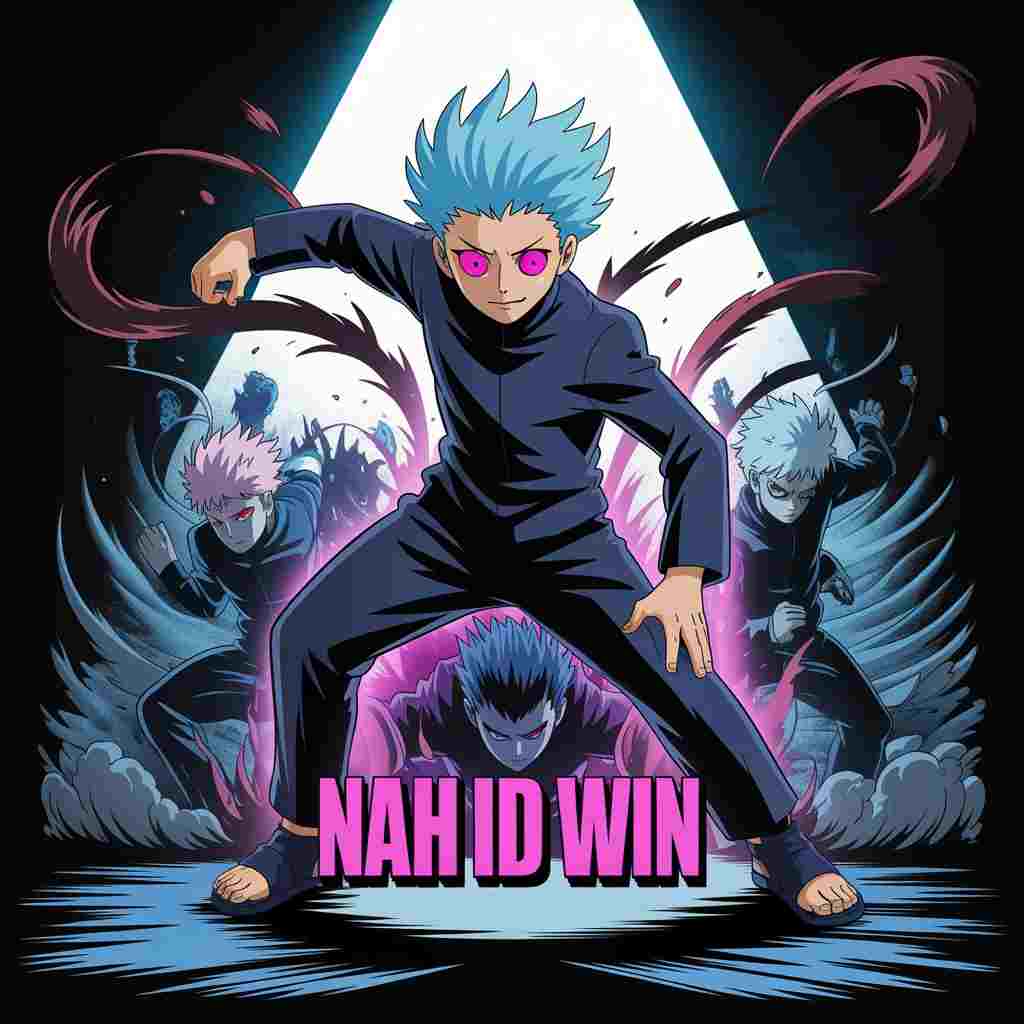
Nah id win is a popular internet phrase associated with Satoru Gojo from the manga and anime series Jujutsu Kaisen. The expression is commonly written as “Nah, I’d win” and is used to show extreme confidence, often in a humorous or ironic way.
The phrase became especially recognisable after a memorable Gojo panel connected with his confrontation with Sukuna. It later developed into a widely reused meme format, with users changing the character, editing the speech bubble, or applying the phrase to completely unrelated situations. Meme references describe it as both a catchphrase and an exploitable image format.
For people searching for nah id win meaning, the simplest explanation is that it means “No, I would win.” In internet culture, however, the phrase usually carries more attitude than its literal meaning suggests.
What Does Nah Id Win Mean?
It is an informal way of saying that someone believes they would win a particular challenge or confrontation.
The phrase can be serious when discussing fictional characters, but it is more commonly used as a joke. Someone may respond with even when the situation clearly suggests that they have almost no chance.
For example, imagine someone asks:
“Would you survive against the strongest character in the series?”
A humorous response could simply.
The joke comes from the confidence of the answer. There is no explanation, hesitation, or attempt to consider the odds.
That simple structure is what makes the phrase effective as a reaction and meme.
Where Did Nah Id Win Come From?
The phrase comes from Jujutsu Kaisen and is strongly connected to Satoru Gojo.
The famous meme image comes from Chapter 221, where Gojo returns to the story, and the situation moves toward his confrontation with Sukuna. The final page became particularly memorable because Gojo gives a confident response that recalls an earlier conversation from the manga.
The English wording also became an important part of the meme’s history. Different English translations presented the response differently, including versions equivalent to “No” and “I will win.” The version that became widely recognised online was “Nah, I’d win,” which connects the scene to Gojo’s earlier statement.
Satoru Gojo
Satoru Gojo is the character most closely associated with nah id win.
Gojo’s personality makes the phrase particularly suitable for him. He is confident, relaxed under pressure, and often speaks as though overwhelming opponents is not a serious concern.
The phrase therefore feels natural when connected to his character.
The meme became even more recognisable because the original panel provides a simple visual format. The close-up image and speech bubble can easily be recreated, edited, redrawn, or replaced with another character.
As a result, the original Gojo image became more than a single manga panel. It became a reusable meme template.
Why Is Nah Id Win a Meme?
The phrase became a meme because it works in many different contexts.
The basic joke is built around an exaggerated response to a difficult situation.
Someone might post a picture of an impossible challenge and add nah id win. Another person might use the phrase when discussing an imaginary battle between fictional characters.
The phrase can also be used when someone clearly should not be confident.
That contrast creates the humour.
For example, if a person has never played a particular video game and someone asks whether they could defeat its final boss without preparation, replying creates an intentionally ridiculous level of confidence.
The phrase does not need a detailed explanation. The audience understands that the confidence itself is the joke.
Nah Id Win Meme Explained
The meme usually appears in one of two forms.
The first is a simple text based reaction. Someone describes a challenge, and another person responds with nah id win.
The second is the visual meme based on the Gojo panel. Users can modify the image, replace the character, change the speech bubble, or recreate the composition using another fictional character.
This flexibility helped the meme move outside the Jujutsu Kaisen community. Meme creators have used the format with characters from other anime, cartoons, games, movies, and online communities.
The original format is therefore recognisable even when the surrounding context has nothing to do with Jujutsu Kaisen.
What Does Nah Id Win Mean in Slang?
In slang, usually expresses confidence.
“There is no chance I would lose.”
“I know this looks impossible, but I am still confident.”
The phrase can also be deliberately ironic.
A person does not necessarily believe they would actually win. They may be using the expression because the situation is so difficult that an overly confident answer becomes funny.
This distinction is important when understanding nah id win meaning. The phrase is not always a literal prediction.
Why Do People Say Nah Id Win?
People use nah id win because it is short, recognisable, and easy to apply to almost any situation.
Online conversations often favour expressions that can communicate an idea quickly. Instead of writing a long explanation about why someone believes they would succeed, the user can simply write nah id win.
The phrase also carries an established cultural reference.
For Jujutsu Kaisen fans, it immediately recalls Gojo. For people who know the broader meme, it represents exaggerated confidence even without knowledge of the original manga.
That dual meaning gives the phrase a wider reach.
Nah Id Win and Jujutsu Kaisen
Jujutsu Kaisen is essential to understanding the original context.
The story follows Yuji Itadori and his involvement with the world of jujutsu sorcerers, cursed energy, and powerful supernatural threats. Satoru Gojo is one of the central characters and is presented as an exceptionally powerful sorcerer.
His confidence regarding Sukuna is therefore connected to the story’s larger power struggle.
The phrase became especially memorable because Gojo’s answer is so direct. Rather than giving a long explanation, he simply expresses confidence.
That characteristic makes the dialogue particularly suitable for meme culture.
What Chapter Is Nah Id Win From?
The famous meme panel comes from Chapter 221 of Jujutsu Kaisen.
The phrase also has an important connection to Chapter 3, where Gojo gives a similar answer during a conversation with Yuji about Sukuna.
The later use of the phrase works as a callback to that earlier scene. Sources documenting the meme’s origin specifically identify Chapter 221 as the source of the famous panel and Chapter 3 as the earlier reference.
This connection is one reason the line became more meaningful to readers who followed the manga closely.
Nah Id Win Gojo Meme
The nah id win Gojo meme normally uses the recognisable image of Gojo with the famous speech bubble.
Some versions keep the original wording intact. Others replace the words with a different response for comedic effect.
There are also versions where Gojo is replaced with another character.
The format works because viewers already understand the visual structure. Once the image is recognised, the new caption becomes the punchline.
This is common in internet meme culture, where a memorable image can become a template that users repeatedly adapt.
Nah Id Win vs Nah I’d Win
“Nah id win” is the simplified internet version. Users often leave out punctuation and apostrophes when writing search queries, captions, comments, or meme text.
Both versions are therefore associated with the same Gojo meme.
Other common variations include:
Gojo I’d win
Gojo nah I’d win
Jujutsu Kaisen nah I’d win
nah id win anime meme
These variations generally represent the same search intent.
How to Use Nah Id Win
The phrase is mainly suitable for casual conversations, social media posts, comments, memes, and fictional discussions.
For example:
“Everyone says the challenge is impossible. Nah id win.”
“Would you survive that fight? Nah id win.”
“They gave me the hardest level first. Nah id win.”
“Everyone thinks the character would lose. Nah id win.”
The phrase can also be used by itself as a reaction.
“Nah I’d win.”
Because it is closely connected to meme culture, it usually works better in informal communication than in professional or academic writing.
Why Is the Phrase Funny?
The humour comes from the difference between the situation and the response.
If the challenge is easy, saying “I’d win” is not particularly funny.
If the challenge is obviously impossible, the same statement becomes humorous because it ignores the apparent odds.
The phrase also carries the personality of Gojo. His confidence is part of his character, so using the same words for an ordinary person or an unrelated character creates an amusing contrast.
This is one reason the phrase became such an effective meme format.
How the Meme Spread
The meme initially circulated among Jujutsu Kaisen fans, particularly in communities focused on manga discussion and fan created content.
Users began editing the panel and changing the wording. Others replaced Gojo with different characters.
The format later spread social media platforms, including TikTok and Reddit, where users could combine the image with short captions, edits, slideshows, and reaction content. Documentation of the meme’s spread describes a major increase in remixes and character replacements across those communities.
This helped transform the phrase from a specific Jujutsu Kaisen reference into a broader internet expression.
Nah Id Win Meme Templates
A template normally refers to an editable version of the recognisable Gojo panel.
Users can modify the speech bubble or recreate the scene with another character.
Common searches include:
nah id win template
nah I’d win template
Gojo nah id win template
JJK nah id win template
These templates are popular because they require very little explanation. The visual structure already communicates the intended joke.
Is Nah Id Win Still Recognisable?
Yes. The phrase remains strongly associated with Gojo and Jujutsu Kaisen and is also recognisable as a general internet expression of exaggerated confidence.
Its continued use is partly explained by the simplicity of the phrase. Unlike memes that depend entirely on a specific event, nah id win can be adapted to new situations.
Someone who has never read the manga can still understand the basic joke, while Jujutsu Kaisen fans can appreciate the original reference.
That gives the expression two levels of meaning.
FAQs
What does nah id win mean?
Nah id win means “Nah, I would win.” Online, it is generally used as a confident or humorous response to a challenge or hypothetical situation.
Who said nah id win?
Satoru Gojo is the character most closely associated with the phrase in Jujutsu Kaisen.
Is nah id win from Jujutsu Kaisen?
Yes. The famous meme comes from a Jujutsu Kaisen manga panel featuring Satoru Gojo.
What chapter is the nah id win meme from?
The famous Gojo panel comes from Chapter 221, while the phrase recalls an earlier Gojo statement from Chapter 3.
Why is nah id win associated with Gojo?
Gojo is known for his extreme confidence and his position as one of the most powerful characters in Jujutsu Kaisen. The phrase fits his personality and became attached to his memorable manga panel.
Conclusion
Nah id win became popular because it combines a memorable character, a recognisable manga panel, simple language, and exaggerated confidence.
The phrase originally belongs to the world of Jujutsu Kaisen and is strongly connected to Satoru Gojo and his attitude toward Sukuna. However, its meaning has expanded through internet culture.
Today, someone can use nah id win without discussing anime at all. It can work as a reaction to a difficult task, an imaginary battle, a competitive situation, or any scenario where exaggerated confidence creates the joke.
The expression is short enough to function as a caption and recognisable enough to work as a meme template. That combination explains why the phrase continues to appear across anime communities and wider online conversations.
For anyone searching for nah id win meaning, the key idea is simple: it is an informal expression of confident refusal to accept defeat, made famous by Satoru Gojo and transformed into one of the recognisable meme formats associated with Jujutsu Kaisen.






Leave a Reply