

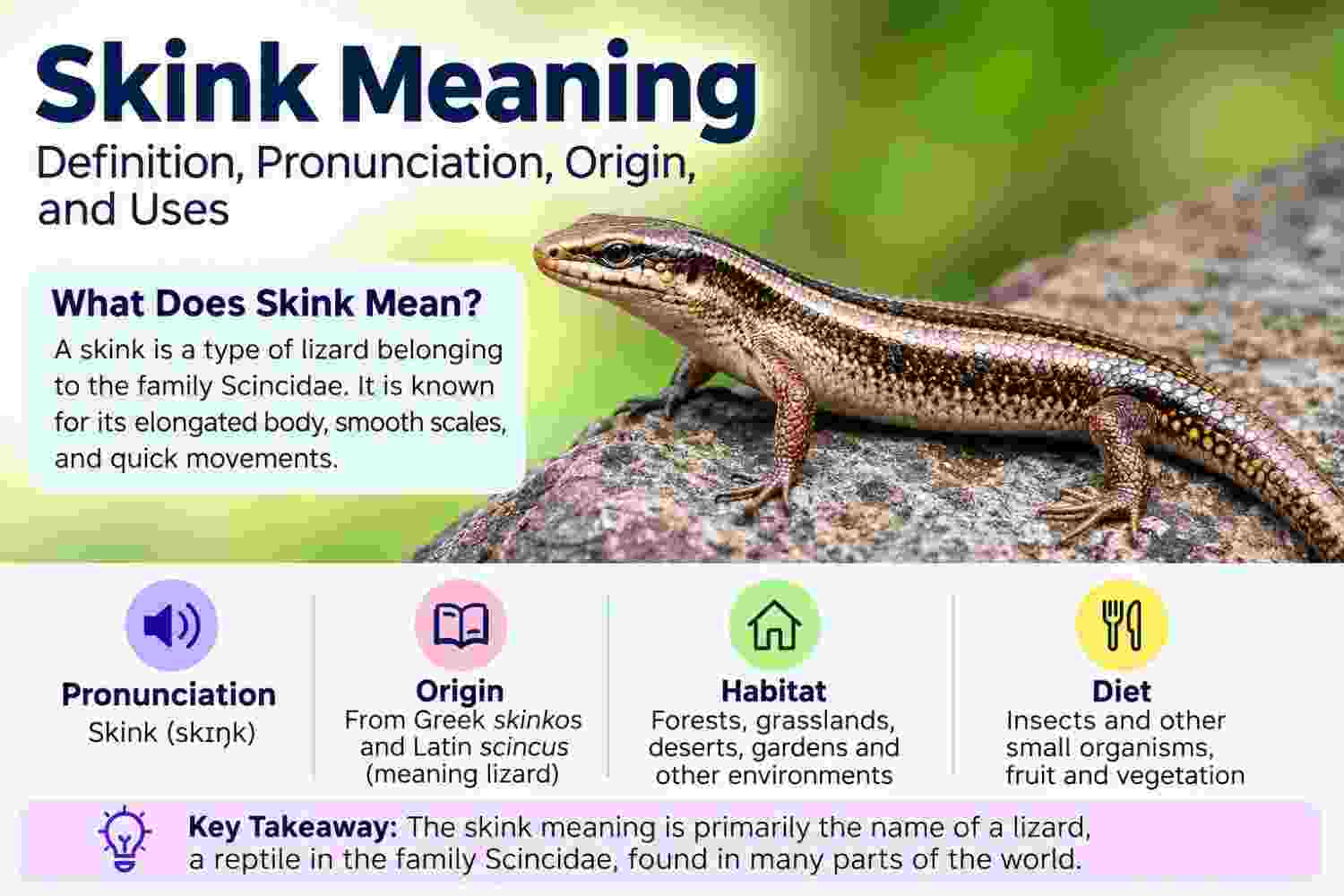
The term skink meaning usually refers to a type of lizard belonging to the family Scincidae. Skinks are reptiles recognised for their elongated bodies, smooth overlapping scales, relatively short legs in many species, and quick movements. They occur in many parts of the world and occupy habitats ranging from forests and grasslands to deserts and areas around human settlements. Cambridge Dictionary defines a skink simply as a small lizard found in various hot parts of the world, while Collins gives a more specific description of members of the Scincidae family.
Although the word looks unusual, its primary modern meaning is straightforward. If you encounter “skink” in a wildlife guide, school textbook, nature article, or zoological discussion, it almost certainly refers to the reptile rather than a slang expression.
What Does Skink Mean?
The simplest answer to what does skink mean is: a skink is a type of lizard.
Scientifically, skinks are members of the reptile family Scincidae. They vary considerably in size, colour, body shape, habitat, and behaviour. Some have ordinary looking lizard proportions, whereas others have highly elongated bodies and very small or reduced limbs.
The word is a noun in its normal modern use. For example:
- “We saw a skink under the rock.”
- “The skink quickly disappeared into the grass.”
- “Researchers identified several skink species in the region.”
In each example, the word refers to an animal.
Skink Meaning in Simple English
In simple English, the meaning can be explained as “a small or medium sized lizard with a long body and smooth scales.”
That explanation is useful for learners because skinks can sometimes resemble small snakes. However, a skink is a lizard, not a snake. Many species have four legs, while some have limbs that are greatly reduced. Their smooth, shiny scales can also make them look different from the rougher looking lizards people commonly picture.
Skinks are generally shy animals. When disturbed, many prefer to escape quickly rather than confront a person.
What Is a Skink?
A skink is a reptile within the family Scincidae. The group contains a very large diversity of lizards distributed across different regions of the world.
Their appearance differs between species. Some skinks have brown or grey colouring that helps them blend into soil, stones, leaves, or tree bark. Others have striking colours and patterns. Body length also varies, so there is no single physical appearance that represents every skink.
Common characteristics can include:
- Smooth or shiny overlapping scales
- An elongated body
- A long tail
- Short legs in many species
- Strong movement across the ground
- Adaptations for burrowing, climbing, or living among vegetation
- A diet that may include insects and other small organisms
The precise characteristics depend on the species.
Is a Skink a Lizard?
Yes. A skink is a lizard.
This is one of the most important points when understanding the skink meaning. Skinks belong to the lizard group rather than the snake group, even though some species have long bodies and short limbs that can create a snake like appearance.
Their classification as lizards is reflected in major English dictionaries. Merriam Webster describes a skink as a member of a family of typically small insectivorous lizards with long tapering bodies.
Skink Pronunciation
The word skink is pronounced approximately like “skink,” rhyming with words such as “think” and “link.”
Cambridge gives the pronunciation as /skɪŋk/ in both British and American English.
This pronunciation is useful for English learners because the spelling can initially make the word seem unfamiliar.
A simple pronunciation guide is:
Skink = skink
The first sound is “sk,” followed by the short “i” sound found in “sit,” and ending with the “nk” sound found in “think.”
Skink Meaning in Biology
In biology, the word has a more specific meaning than the general phrase “small lizard.”
A biological definition identifies a skink as a member of the family Scincidae. This family contains many different species with different physical and ecological adaptations.
Some skinks are terrestrial and spend much of their time moving through leaf litter or soil. Others can climb or occupy vegetation. Certain species are adapted to particularly dry environments, while others live in humid habitats.
Consequently, it is better to think of “skink” as the name of a broad lizard family rather than the name of one particular animal.
What Do Skinks Eat?
Many skinks eat insects and other small invertebrates. Depending on the species, diet can also include other small animals, fruit, vegetation, or a mixture of foods.
The exact diet therefore depends on the individual species and its environment.
A skink living in a garden may encounter insects, spiders, larvae, and other small creatures. In natural habitats, food availability can change according to season, rainfall, vegetation, and temperature.
This makes skinks relevant to local ecosystems because they can form part of the food web while also feeding on smaller organisms.
Where Do Skinks Live?
Skinks occur across a wide geographical range. Collins notes that they are particularly common in tropical Africa and Asia, while dictionaries also describe the family as widely distributed across different parts of the world.
Their habitats can include:
- Forests
- Grasslands
- Rocky areas
- Deserts
- Gardens
- Woodland floors
- Scrubland
- Areas beneath stones or fallen vegetation
Their ability to occupy different environments is one reason the term covers such a diverse group of reptiles.
Why Do Skinks Look Like Snakes?
Some skinks have long bodies and reduced limbs, creating a snake like appearance. This is one reason people who see one for the first time may be uncertain about what they have found.
The difference becomes clearer when examining anatomy. Skinks are lizards, and many species retain limbs, although limb development varies considerably across the family.
Their elongated shape can be an adaptation associated with movement through soil, leaf litter, vegetation, or narrow spaces. The result is a group of lizards that can look quite different from the stereotypical short bodied lizard.
Are Skinks Dangerous?
Most skinks are not dangerous to people and generally avoid human contact.
When approached, a skink will often attempt to escape by running toward vegetation, rocks, cracks, or another sheltered location. As with any wild animal, however, it is sensible not to handle an unfamiliar species unnecessarily.
If someone finds a skink in a garden or outdoor area, observing it from a distance is usually preferable to chasing or catching it.
Skink Meaning and Word Origin
The linguistic history of skink meaning is older than its modern everyday use might suggest.
The reptile sense comes from the Latin scincus, which in turn derives from the Greek skinkos, meaning a lizard. Dictionary sources place the word’s recorded English history centuries ago. Dictionary.com traces the reptile noun to the Latin and Greek forms, while Merriam-Webster gives the first known use of the noun as 1590.
There is also a separate historical verb skink, associated with Scottish dialect, meaning to serve or pour a drink. Merriam Webster and Collins both record this older dialectal usage.
Therefore, context matters when reading older literature.
Does Skink Have a Slang Meaning?
The primary dictionary meaning of skink is the reptile. Some websites and online communities use the word informally or as niche slang, but those uses are not as established or universal as the zoological definition.
Online slang explanations sometimes describe “skink” as a playful term for someone sneaky, slippery, annoying, or difficult to trust. However, these meanings can vary substantially between communities and should not be treated as the standard English definition.
If you see “skink” in a scientific, educational, wildlife, or nature context, the animal meaning should be your first interpretation.
Skink Meaning in Different Contexts
Understanding the surrounding sentence makes the word much easier to interpret.
Wildlife context:
“The skink moved beneath the fallen leaves.”
Here, skink clearly means the reptile.
Educational context:
“Skinks belong to the family Scincidae.”
Here, the word has a scientific classification.
Informal online context:
“That guy is such a skink.”
Here, it may be slang or a community specific expression rather than a zoological reference.
Historical Scottish context:
“He skinked the drink.”
Here, the word may relate to the older verb meaning to serve or pour a beverage.
Skink Meaning for English Learners
For English learners, the easiest way to remember the word is:
Skink = a type of lizard.
You can then add the scientific detail: skinks belong to the family Scincidae.
A useful vocabulary sentence is:
“A skink is a lizard with smooth scales and, in many species, an elongated body.”
Learning the word this way avoids confusion with snakes and makes it easier to recognise the term in nature articles, documentaries, textbooks, and general reading.
Skinks and Wildlife Observation in Cities
The word can also appear when people research wildlife they encounter while travelling. London, for example, has an extensive programme of museums, parks, gardens, zoos, and outdoor experiences during summer 2026. Visit London lists attractions and events ranging from Kew Gardens and London Zoo to Shakespeare’s Globe and Thames experiences.
This does not mean skinks are a defining feature of London’s urban wildlife. Rather, it illustrates why understanding animal vocabulary can be useful when reading museum displays, wildlife material, travel guides, or educational information.
For visitors in London during August 2026, practical planning also matters. The city has major seasonal events including the BBC Proms, All Points East, the Greenwich+Docklands International Festival, and Notting Hill Carnival. Some venues require booking, while others are free or operate on an event-specific basis.
If a wildlife related attraction is included in a London itinerary, checking the venue’s current opening hours, ticket requirements, accessibility information, and transport arrangements before travelling is sensible.
Skink Meaning vs. Lizard Meaning
The two terms are related but are not interchangeable in every context.
“Lizard” is a broad everyday word covering many reptiles within the lizard group. “Skink” identifies a particular family of lizards, Scincidae.
Therefore:
Lizard: broad category
Skink: particular group of lizards
Scincidae: scientific family containing skinks
This distinction is particularly useful in biology and educational writing.
Common Questions About Skink Meaning
What does skink mean?
Skink means a type of lizard belonging to the family Scincidae. The animals are commonly recognised by their smooth scales and elongated bodies.
Is a skink a snake?
No. A skink is a lizard, although some species have long bodies and reduced limbs that can make them look snake like.
Is a skink dangerous?
Skinks are generally harmless to humans and normally avoid people. Their behaviour varies by species, so wild animals should still be observed without unnecessary handling.
What is the scientific name for a skink?
Skinks belong to the family Scincidae. “Skink” is therefore a common name for members of this diverse lizard family.
How do you pronounce skink?
Skink is pronounced /skɪŋk/, approximately rhyming with “think” and “link.”
Final Takeaway
The skink meaning is primarily the name of a lizard belonging to the family Scincidae. Skinks are diverse reptiles with smooth scales, elongated bodies, and species specific adaptations that allow them to live in environments ranging from forests and grasslands to dry regions.
The word is pronounced /skɪŋk/ and has a long linguistic history connected to Greek and Latin terms for lizards. Older dictionaries also record a separate Scottish verb meaning to serve a drink. In modern English, however, the reptile meaning is overwhelmingly the most useful interpretation.
When you encounter the word in a sentence, the surrounding context should determine whether it refers to the animal, an older historical usage, or a niche informal expression. For most readers, remembering one simple definition is enough: a skink is a type of lizard.










Leave a Reply