
If you have searched for “anonvault,” you have probably noticed something odd. Many websites use that name, and many blog posts talk about it as if it were a famous product. But when you try to find out who runs it or whether anyone has tested it, the trail goes cold very fast.
This guide explains what people mean by AnonVault, what these services usually promise, and how to decide whether any of them deserves your trust.
What Is AnonVault?
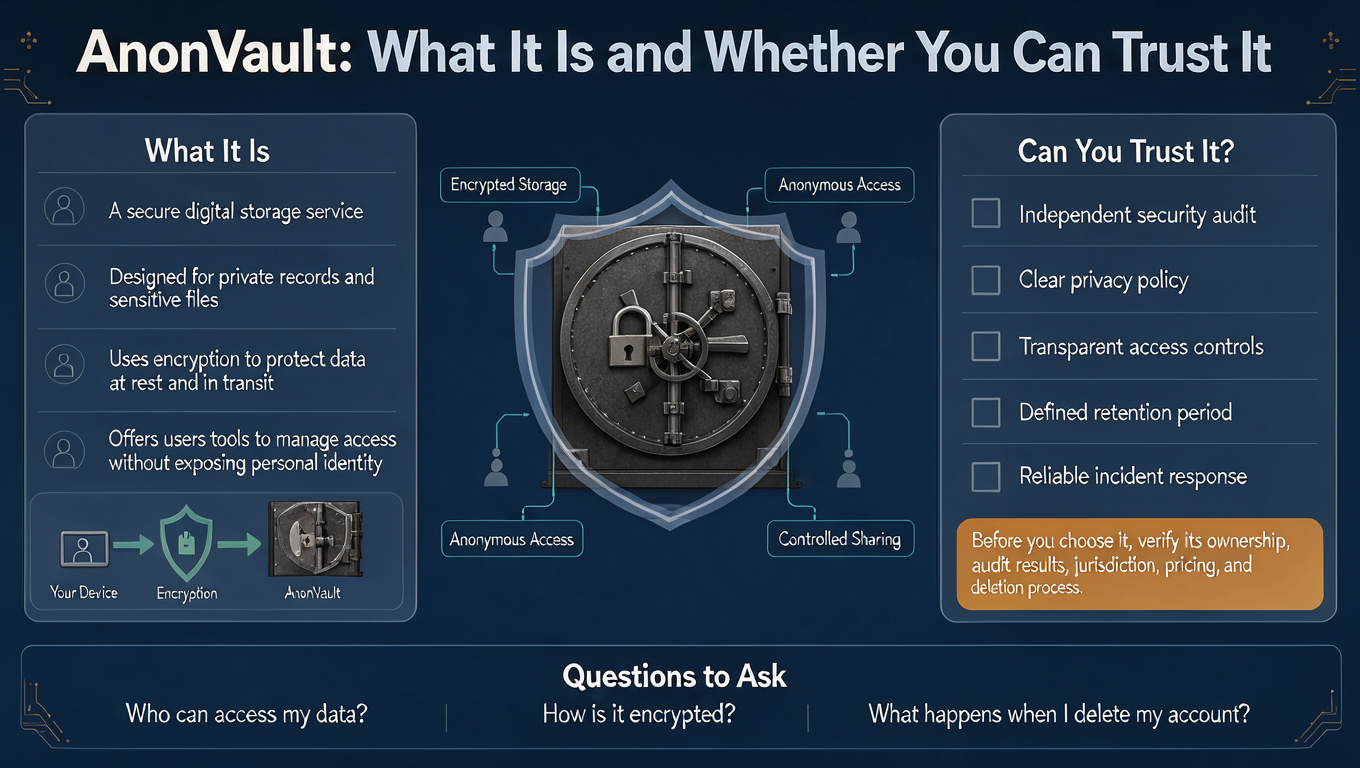
AnonVault is the name given to a type of online storage that promises privacy. You upload files, such as documents, photos, or backup notes, and nobody should be able to see them except you. You also should not have to give your name, email, or phone number to get started.
The tricky part is that “AnonVault” is not one company. Several unrelated websites use the name, with endings like .com, .net, and .blog. None of them clearly say who owns them. So it is more accurate to treat AnonVault as a kind of service people search for, not a single trusted brand. If an article says “AnonVault is safe,” ask which one it means. The answer is usually unclear, and that is your first warning sign.
Why People Look for Anonymous Storage
Privacy is not a niche worry anymore. Almost everyone knows someone whose account was hacked or whose data leaked in a company breach. When your files sit on a big company’s servers, you are trusting that company to protect them and treat you fairly.
Journalists use private storage to protect their sources. Activists use it when governments watch the internet closely. Business owners and crypto holders use it when they do not want important records tied to one service. Wanting privacy is not the same as having something to hide. People close their curtains at night for the same reason.
What AnonVault Sites Usually Promise
Most pages repeat the same promises. The first is strong encryption, usually called AES-256. It scrambles your file so it looks like random noise to anyone without the key. It is a real, respected standard. What matters is where the scrambling happens. In a well-built service, your file is locked on your own device before upload, so the company only stores the scrambled version.
The second promise is “zero-knowledge,” which means the company cannot read your files because it never has your key. The third is anonymous sign-up with no email, often paired with payment in cryptocurrency. Some sites add extras, like splitting files across many computers or connecting through Tor.
Every one of these ideas is real. But a claim on a website is not proof. Anyone can type “military-grade encryption” on a page. The real question is whether anyone has checked.
Strong Encryption Is Not Enough
Many people think that if a service says AES-256, the job is done. It is not. Encryption is like a strong lock, but if the door frame is weak, the lock does not help.
A good example is MEGA, a well-known storage service. In 2022, researchers from ETH Zurich found weaknesses in how it handled keys. The math was fine, but the way the pieces were put together was not. MEGA fixed the problems, yet it shows that even a serious company can make mistakes. A service with no public code, no outside review, and no named team could easily make the same mistakes, and you would never know.
Payment and Connection Still Matter
Hiding your name is only part of staying private. A service can ask for no email and still learn about you from how you pay and where you connect from. Paying by card links your bank record to the service. Crypto helps, but most coins leave a public trail, and payments can sometimes be traced.
Your internet address also shows roughly where you are. People use tools like Tor or a trusted VPN to cover it, though none of them are perfect. Privacy works in layers, so be careful with any product that claims to solve everything alone.
AnonVault vs Regular Cloud Storage
Google Drive and Dropbox are easy and fast, but they hold the keys to your files and collect information about you. Privacy-focused services like Proton Drive lock your files on your device and are open about who runs the company and how it works. Most still ask for an email, so they are not fully anonymous, but they have a track record that people can check.
Decentralized options such as Storj spread your files across a large network and publish proof that your data is really stored. They are open about how they work too. AnonVault, on paper, sits at the most private end, with no email and heavy encryption. In practice, you are asked to trust something nobody can look into. The more private a service claims to be, the more proof you should ask for.
Red Flags to Watch For
The biggest red flag is that nobody puts their name on it. If every page hides the owner, you cannot know who holds your data. The second is the lack of any outside check, such as a security report, public code, or coverage from respected technology news sites.
The third is a pile of near-identical blog posts that repeat the same features in the same order. That often means the sites are being promoted for money, not discussed by real users. Even the Vefogix page that ranks for this keyword turned out to be a place where site owners sell guest-post links, not a review. The fourth is copycat domains, since fake sites love to copy popular names. If a site asks for passwords or wallet details unexpectedly, leave. The fifth is pressure to hurry, like “limited time” or “lifetime storage today.”
How to Check Any Privacy Service
You do not need to be an expert. Ask who runs the service and in which country, because that decides which laws apply to your data. Look for an independent audit from a firm such as Cure53, which publishes reports on the services it tests. Check whether the code is public, so others can inspect it.
Also read what the service says about lost keys. A truly private service cannot reset your password, because it never had your key. If a site promises easy recovery and total privacy together, one of those claims is probably false. Finally, search for coverage from respected outlets. If the only sources are lookalike blogs, that tells you something.
What You Can Do Yourself
The best habit is to encrypt sensitive files on your own computer before uploading them anywhere. Then even a weak or dishonest service only gets scrambled data. Keep important backups in more than one place, use a strong unique password, turn on two-step login, and keep your device updated. For anything truly important, such as legal or business documents, choose a service with a public history and an audit.
Read More: Peter Orszag bald
Is AnonVault Legal?
Using private, encrypted storage is legal in most countries. Encryption is part of everyday life, from online banking to messaging apps. But rules around anonymous services and crypto payments are changing and differ by country. If you handle other people’s data or work in a regulated field, use a provider that can prove it meets the required standards, and ask a qualified professional if you are unsure.
The Bottom Line
AnonVault is best understood as an idea, not a product. The idea is good, but the name is used by sites nobody can verify. Before you upload anything you care about, ask who runs the service, look for a real audit, and lock your own files first. The word “anonymous” in a website’s name is a promise, not proof. The services worth trusting are the ones willing to be checked.












Leave a Reply